Custom Search
Showing posts with label Courses. Show all posts

Tuesday, January 3, 2012

Code Division Multiple Access (CDMA)


    CDMA         

Short for Code-Division Multiple Access, a digital cellular technology that uses spread-spectrum techniques. Unlike competing systems, such as GSM, that use TDMA, CDMA does not assign a specific frequency to each user. Instead, every channel uses the full available spectrum. Individual conversations are encoded with a pseudo-random digital sequence. CDMA consistently provides better capacity for voice and data communications than other commercial mobile technologies, allowing more subscribers to connect at any given time, and it is the common platform on which 3G technologies are built.


Code Division Multiple Access (CDMA)

CDMA users share a common frequency channel. All users are on the same frequency at the same time. However, each pair of users is assigned a special code that reduces interference while increasing privacy.

    Advantages of CDMA

Most efficient use of available bandwidth the foremost advantage is the large band width and its equivalent effect utilization for sending and receiving the data.

No separate time Access divisions
In CDMA technology there is no time limitation slot division for using the band width and sending and receiving the data like in TDMA.

Power and bandwidth frequency
Power frequency remains constant in both sending and receiving and uniform bandwidth keeps the transmission faster and in time.

Resource allocation
Another advantage of CDMA is the flexible resource allocation which means that a certain kind of pin code is provide to the active users to communicate with each other. Fixed time and bandwidth keeps the simultaneous exchange of message at both sender and receivers end and specific number of packets with limited length keeps the extra traffic out of the channel.

    Disadvantages of CDMA     

The main disadvantage of CDMA is that it can’t be used for the multi channel or multiple transmission paths. All the communication is performed over a single path. This make it fixed for singular purposes which is main drawback of CDMA technology.

    Space Division Multiple Access (SDMA)  

Space Division Multiple Access (SDMA) - A variation of TDMA and CDMA that potentially will be used in high-bandwidth, third-generation wireless products.

SDMA is a channel access method based on creating parallel spatial pipes next to higher capacity pipes through spatial multiplexing and/or diversity, by which it is able to offer superior performance in radio multiple access communication systems. In traditional mobile cellular network systems, the base station has no information on the position of the mobile units within the cell and radiates the signal in all directions within the cell in order to provide radio coverage. This results in wasting power on transmissions when there are no mobile units to reach, in addition to causing interference for adjacent cells using the same frequency, so called co-channel cells. Likewise, in reception, the antenna receives signals coming from all directions including noise and interference signals. By using smart antenna technology and differing spatial locations of mobile units within the cell, space-division multiple access techniques offer attractive performance enhancements. The radiation pattern of the base station, both in transmission and reception, is adapted to each user to obtain highest gain in the direction of that user. This is often done using phased array techniques.

     Comparison of Multiple Access Systems

 
Comparison of Multiple Access Systems_CDMA_FDMA_TDMA
Comparison of Multiple Access Systems

This table summarizes some of the technical aspects of the multiple access technologies.

The technology used determines the channel's capacity. TDMA triples the capacity of FDMA, but CDMA capacity can be up to seven times that of TDMA.

References:
                   WiFi Notes
                   Wikipedia
                   CDMA University
                   WEBOPEDIA
                   How Stuff Works


" Code Division Multiple Access (CDMA) " !

Saturday, December 10, 2011

Frequency Division Multiple Access (FDMA)


    FDMA                           
Multiple Access Systems-Frequency Division Multiple Access (FDMA)
Frequency Division Multiple Access (FDMA)

Frequency Division Multiple Access or FDMA is a channel access method used in multiple-access protocols as a channelization protocol. FDMA gives users an individual allocation of one or several frequency bands, or channels. It is particularly commonplace in satellite communication. FDMA, like other Multiple Access systems, coordinates access between multiple users.

Each FDMA subscriber is assigned a specific frequency channel. No one else in the same cell or a neighboring cell can use the frequency channel while it is assigned to a user. This reduces interference, but severely limits the number of users.

    Advantage of FDMA                         
 
* FDMA technique doesn't need any base-control station.
* Data that transfeered between each station to another during the transmission process will not be lost.
* After the transmission of data,the effect ot the delay distortion will be so small and it can be ignored.
* There is no need for network timing.
* The channel operations in FDMA are simple.
* In FDMA,the reduction of the information bit rate has a good effect on the capacity.
* No need for any equalization.
* Because of the transmission is continuous,there is almost no need for bits that are responsible for synchronization.
* Simplicity in FDMA algorithms.

    Disadvantages of FDMA                   


* In the FDMA technique,it is impossible for the stations to receive data from more than one transmission source.
* One of most important thing in communication systems is the maximum data rate which is small and fixed for every channel in FDMA.
* Because of the guard bands,the capacity of the FDMA will be decreased.
* Increasing the cost of FDMA,since the band filters are narrow that can't be recognized by VLSI.
* FDMA requires special filters to avoid any interference between the narrow channels.


    TDMA                        
    CDMA                       
    SDMA                        

Reference:

    * Wikipedia
    * CDMA University
    * WEBOPEDIA
    * How Stuff Works   


" Frequency Division Multiple Access (FDMA) " !

Friday, December 9, 2011

Multiple Access Systems


    Why Multiple Access?  
 

Multiple Access systems coordinates access between multiple users.Wireless telecommunications has dramatically increased in popularity, resulting in the need for technologies that allow multiple users to share the same Bandwidth.
The following Multiple Access Systems have very different approaches to the bandwidth problem. 


Multiple Access Systems-Time Division Multiple Access (TDMA)
Time Division Multiple Access (TDMA)

     TDMA                       

Short for Time Division Multiple Access, a technology for delivering digital wireless service using time-division multiplexing (TDM). TDMA works by dividing a radio frequency into time slots and then allocating slots to multiple calls. In this way, a single frequency can support multiple, simultaneous data channels.
The users transmit in rapid succession, one after the other, each using its own time slot. This allows multiple stations to share the same transmission medium (e.g. radio frequency channel) while using only a part of its channel capacity. TDMA is used in the digital 2G cellular systems such as Global System for Mobile Communications (GSM), IS-136, Personal Digital Cellular (PDC) and iDEN, and in the Digital Enhanced Cordless Telecommunications (DECT) standard for portable phones. It is also used extensively in satellite systems, combat-net radio systems, and PON networks for upstream traffic from premises to the operator.
TDMA is a type of Time-division multiplexing, with the special point that instead of having one transmitter connected to one receiver, there are multiple transmitters. In the case of the uplink from a mobile phone to a base station this becomes particularly difficult because the mobile phone can move around and vary the timing advance required to make its transmission match the gap in transmission from its peers.
 

    Advantages of TDMA                       

The radio part of the mobile only needs to listen and broadcast for its own time slot. For the rest of the time, the mobile can carry out measurements on the network, detecting surrounding transmitters on different frequencies. This allows safe inter frequency handovers, something which is difficult in CDMA systems, not supported at all in IS-95 and supported through complex system additions in Universal Mobile Telecommunications System (UMTS). This in turn allows for co-existence of microcell layers with macrocell layers.


    Disadvantages of TDMA                 

TDMA systems create interference at a frequency which is directly connected to the time slot length. This is the buzz which can sometimes be heard if a TDMA phone is left next to a radio or speakers.Another disadvantage is that the "dead time" between time slots limits the potential bandwidth of a TDMA channel. These are implemented in part because of the difficulty in ensuring that different terminals transmit at exactly the times required. Handsets that are moving will need to constantly adjust their timings to ensure their transmission is received at precisely the right time, because as they move further from the base station, their signal will take longer to arrive. This also means that the major TDMA systems have hard limits on cell sizes in terms of range, though in practice the power levels required to receive and transmit over distances greater than the supported range would be mostly impractical anyway.


    FDMA                        
    CDMA                       
    SDMA                        

Reference:
    
    * Wikipedia 
    * CDMA University
    * WEBOPEDIA
    * How Stuff Works


" Multiple Access Systems " !

Saturday, November 12, 2011

GSM Architecture and Definitions (3)


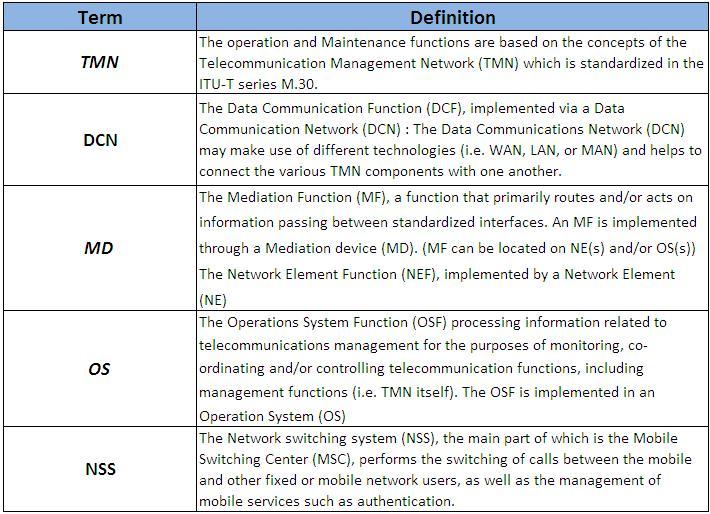
    The Operation and Support System 

The operations and maintenance center (OMC) is connected to all equipment in the switching system and to the BSC. The implementation of OMC is called the operation and support system (OSS). The OSS is the functional entity from which the network operator monitors and controls the system. The purpose of OSS is to offer the customer cost-effective support for centralized, regional, and local operational and maintenance activities that are required for a GSM network. An important function of OSS is to provide a network overview and support the maintenance activities of different operation and maintenance organizations.


GSM Operation and Support System (OSS)
OSS: The operations and maintenance center (OMC) is connected to all equipment in the switching system and to the BSC. The implementation of OMC is called the operation and support system (OSS).
       Here are some of the OMC functions:
       * Administration and commercial operation (subscription, end terminals, charging and statistics).
       * Security Management.
       * Network configuration, Operation and Performance Management.

       * Maintenance Tasks.    

GSM Architecture and Definitions


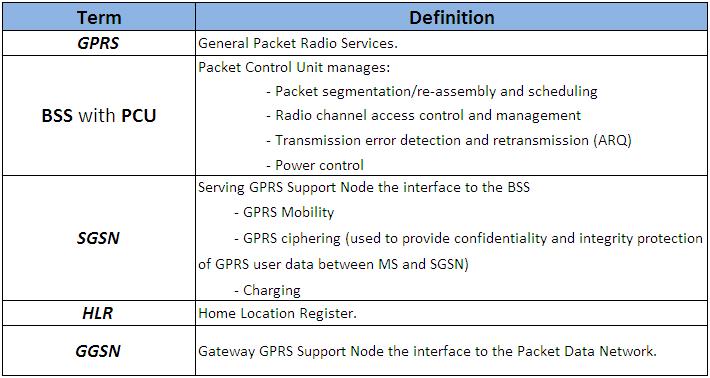
GPRS (General Packet Radio Services
GPRS (General Packet Radio Services)

    
GPRS General Packet Radio Services

GPRS is a data network that overlays a second-generation GSM network. This data overlay network provides packet data transport at rates from 9.6 to 171 kbps. Additionally, multiple users can share the same air-interface resources simultaneously.

GPRS attempts to reuse the existing GSM network elements as much as possible, but to effectively build a packet-based mobile cellular network, some new network elements, interfaces, and protocols for handling packet traffic are required.


GSM Architecture and Definitions


External Networks
  PSTN: Public Switched Telephone Network
  ISDN: Integrated Services Digital Network
  PDN: Packet Data Network

Refferance:
   * Alcatel-Lucent
   * Private Line
   * Tutorials Point 
  * SS7 Training


" GSM Architecture and Definitions (3) " !

GSM Architecture and Definitions (2)


    The Network Switching System  
 

The Network switching system (NSS) is responsible for performing call processing and subscriber-related functions. The switching system includes the following functional units.


GSM Architecture and Definitions
MSC: Mobile Switching Center a switching exchange whose main functions are:
       – Call Handling
       – Specific GSM functions such as:
         • Mobility Management: Communication with the Location Databases (VLR
           and HLR)
         • Handover execution when involved
       – Gateway Function for Terminating Call (TC)
    VLR: Visitor Location Register is associated with one or more MSC. It is a local database with the following
         information:
         – Copy of the HLR data for visiting subscribers
         – More precise location of the Mobile Station (an area of the network called
           “Location Area” which is a group of cells

         – Call re-direction data


GSM Architecture and Definitions

                                                                                                                                                      Next  

Refferance:    
                   * Alcatel-Lucent    
                   * Private Line    
                   * Tutorials Point    
                   * SS7 Training


" GSM Architecture and Definitions (2) " !

GSM Architecture and Definitions (1)


    What is GSM?           

GSM, which stands for Global System for Mobile communications, reigns as the world’s most widely used cell phone technology. Cell phones use a cell phone service carrier’s GSM network by searching for cell phone towers in the nearby area.

The origins of GSM can be traced back to 1982 when the Groupe Spécial Mobile (GSM) was created by the European Conference of Postal and Telecommunications Administrations (CEPT) for the purpose of designing a pan-European mobile technology.


It is approximated that 80 percent of the world uses GSM
GSM Architecture and Definitions
technology when placing wireless calls, according to the GSM
Association (GSMA), which represents the interests of the worldwide mobile communications industry. This amounts to nearly 3 billion global people.

    GSM Network Structure   

The network is structured into a number of discrete sections:

   *  The Base Station Subsystem (the base stations and their controllers).
   *  The Network and Switching Subsystem (the part of the network most similar to a fixed network). This is sometimes also just called the core network.
   * The GPRS Core Network (the optional part which allows packet based Internet connections).
   *  The Operations support system (OSS) for maintenance of the network.
 

Now,We will explain the meaning of the GSM Network shortcuts.

PLMN: Public Land Mobile Network is area covered by one network operator. A PLMN can contain one or more MSCs.
GSM: Global System for Mobile communication
  MS: Mobile Station is used by the subscriber for calling another subscriber either in the fixed network or in the mobile network.A Mobile Station (MS) is composed of a Mobile Termination (MT) and a Subscriber Module Identity (SIM) card.
   MT: Mobile Termination.The MT performs the following functions:
       - radio transmission termination;
       - radio transmission channel management;
       - terminal capabilities, including presentation of a  man-machine interface to a user;
       - speech encoding/decoding;
       - error protection for all information sent across the radio path;
       - flow control of signalling and user data;
       - rate adaptation of user data between the radio channel rate and user rates;
       - multiple terminal support;
       - mobility management.

SIM: SIM card stores information concerning the subscriber such as subscriber identity,services subscribed, parameters for security procedures and information on the location of the subscriber (dynamically refreshed according to its movements).
  Um > The Radio Interface between MS and Base Station.
     UpLink: The Path of the Data from MS to Base Station.
     DownLink: The Path of the Data from Base Station to MS.


GSM Architecture and Definitions


GSM Architecture and Definitions

                                                                                                   Next
Refferance:
   * Alcatel-Lucent
   * Private Line
   * Tutorials Point 
  * SS7 Training


" GSM Architecture and Definitions (1) " !

Friday, May 6, 2011

Introduction to Cellular Communications (2)

3. Cellular System Architecture

Increases in demand and the poor quality of existing service led mobile service providers to research ways to improve the quality of service and to support more users in their systems. Because the amount of frequency spectrum available for mobile cellular use was limited, efficient use of the required frequencies was needed for mobile cellular coverage. In modern cellular telephony, rural and urban regions are divided into areas according to specific provisioning guidelines. Deployment parameters, such as amount of cell-splitting and cell sizes, are determined by engineers experienced in cellular system architecture.
Provisioning for each region is planned according to an engineering plan that includes cells, clusters, frequency reuse, and handovers.

Cells

A cell is the basic geographic unit of a cellular system. The term cellular comes from the honeycomb shape of the areas into which a coverage region is divided. Cells are base stations transmitting over small geographic areas that are represented as hexagons. Each cell size varies depending on the landscape. Because of constraints imposed by natural terrain and man-made structures, the true shape of cells is not a perfect hexagon.

Clusters

A cluster is a group of cells. No channels are reused within a cluster. Figure 4 illustrates a seven-cell cluster.

A cluster is a group of cells

Frequency Reuse

Because only a small number of radio channel frequencies were available for mobile systems, engineers had to find a way to reuse radio channels to carry more than one conversation at a time. The solution the industry adopted was called frequency planning or frequency reuse. Frequency reuse was implemented by restructuring the mobile telephone system architecture into the cellular concept.
The concept of frequency reuse is based on assigning to each cell a group of radio channels used within a small geographic area. Cells are assigned a group of channels that is completely different from neighboring cells. The coverage area of cells is called the footprint. This footprint is limited by a boundary so that the same group of channels can be used in different cells that are far enough away from each other so that their frequencies do not interfere. 
Frequency Reuse
Frequency Reuse

Cells with the same number have the same set of frequencies. Here, because the number of available frequencies is 7, the frequency reuse factor is 1/7. That is, each cell is using 1/7 of available cellular channels.

Cell Splitting

Unfortunately, economic considerations made the concept of creating full systems with many small areas impractical. To overcome this difficulty, system operators developed the idea of cell splitting. As a service area becomes full of users, this approach is used to split a single area into smaller ones. In this way, urban centers can be split into as many areas as necessary to provide acceptable service levels in heavy-traffic regions, while larger, less expensive cells can be used to cover remote rural regions.

Cell Splitting
Cell Splitting

Handoff

The final obstacle in the development of the cellular network involved the problem created when a mobile subscriber traveled from one cell to another during a call. As adjacent areas do not use the same radio channels, a call must either be dropped or transferred from one radio channel to another when a user crosses the line between adjacent cells. Because dropping the call is unacceptable, the process of handoff was created. Handoff occurs when the mobile telephone network automatically transfers a call from radio channel to radio channel as a mobile crosses adjacent cells.
                                                                             
Cell Phone Handoff
Cell Phone Handoff


During a call, two parties are on one voice channel. When the mobile unit moves out of the coverage area of a given cell site, the reception becomes weak. At this point, the cell site in use requests a handoff. The system switches the call to a stronger-frequency channel in a new site without interrupting the call or alerting the user. The call continues as long as the user is talking, and the user does not notice the handoff at all.


------------------------------------------------------------------------
Source : http://www.gsmfavorites.com/

" Introduction to Cellular Communications (2) " !

Introduction to Cellular Communications (1)


1. Mobile Communications Principles

Cellular Communications
Each mobile uses a separate, temporary radio channel to talk to the cell site. The cell site talks to many mobiles at once, using one channel per mobile. Channels use a pair of frequencies for communication one frequency (the forward link) for transmitting from the cell site and one frequency (the reverse link) for the cell site to receive calls from the users. Radio energy dissipates over distance, so mobiles must stay near the base station to maintain communications. The basic structure of mobile networks includes telephone systems and radio services. Where mobile radio service operates in a closed network and has no access to the telephone system, mobile telephone service allows interconnection to the telephone network.
Early Mobile Telephone System Architecture
Traditional mobile service was structured in a fashion similar to television broadcasting: One very powerful transmitter located at the highest spot in an area would broadcast in a radius of up to 50 kilometers. The cellular concept structured the mobile telephone network in a different way. Instead of using one powerful transmitter, many low-power transmitters were placed throughout a coverage area. For example, by dividing a metropolitan region into one hundred different areas (cells) with low-power transmitters using 12 conversations (channels) each, the system capacity theoretically could be increased from 12 conversations or voice channels using one powerful transmitter to 1,200 conversations (channels) using one hundred low-power transmitters. Figure 2 shows a metropolitan area configured as a traditional mobile telephone network with one high-power transmitter.

2. Mobile Telephone System Using the Cellular Concept

Interference problems caused by mobile units using the same channel in adjacent areas proved that all channels could not be reused in every cell. Areas had to be skipped before the same channel could be reused. Even though this affected the efficiency of the original concept, frequency reuse was still a viable solution to the problems of mobile telephony systems.
Engineers discovered that the interference effects were not due to the distance between areas, but to the ratio of the distance between areas to the transmitter power (radius) of the areas. By reducing the radius of an area by 50 percent, service providers could increase the number of potential customers in an area fourfold. Systems based on areas with a one-kilometer radius would have one hundred times more channels than systems with areas 10 kilometers in radius. Speculation led to the conclusion that by reducing the radius of areas to a few hundred meters, millions of calls could be served.
The cellular concept employs variable low-power levels, which allow cells to be sized according to the subscriber density and demand of a given area. As the population grows, cells can be added to accommodate that growth. Frequencies used in one cell cluster can be reused in other cells. Conversations can be handed off from cell to cell to maintain constant phone service as the user moves between cells.
The cellular radio equipment (base station) can communicate with mobiles as long as they are within range. Radio energy dissipates over distance, so the mobiles must be within the operating range of the base station. Like the early mobile radio system, the base station communicates with mobiles via a channel. The channel is made of two frequencies, one for transmitting to the base station and one to receive information from the base station.

---------------------------------------------------------------------
Source : gsmfavorites

" Introduction to Cellular Communications (1) " !

Wednesday, May 4, 2011

The GSM Network

The GSM Network
The GSM Network

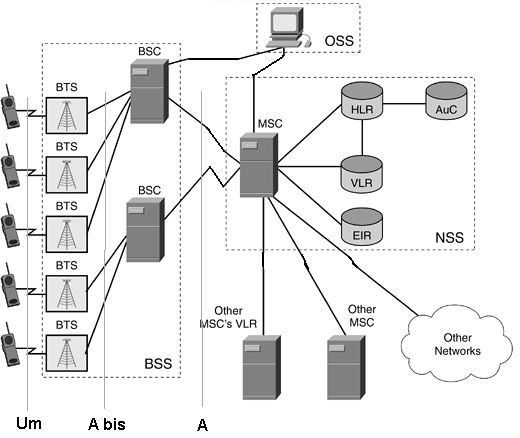
GSM provides recommendations, not requirements. The GSM specifications define the functions and interface requirements in detail but do not address the hardware. The reason for this is to limit the designers as little as possible but still to make it possible for the operators to buy equipment from different suppliers. The GSM network is divided into three major systems: the switching system (SS), the base station system (BSS), and the operation and support system (OSS).

The Switching System

The switching system (SS) is responsible for performing call processing and subscriber-related functions. The switching system includes the following functional units.
  • home location register (HLR):The HLR is a database used for storage and management of subscriptions. The HLR is considered the most important database, as it stores permanent data about subscribers, including a subscriber's service profile, location information, and activity status. When an individual buys a subscription from one of the PCS operators, he or she is registered in the HLR of that operator.
  • mobile services switching center (MSC):The MSC performs the telephony switching functions of the system. It controls calls to and from other telephone and data systems. It also performs such functions as toll ticketing, network interfacing, common channel signaling, and others.
  • visitor location register (VLR):The VLR is a database that contains temporary information about subscribers that is needed by the MSC in order to service visiting subscribers. The VLR is always integrated with the MSC. When a mobile station roams into a new MSC area, the VLR connected to that MSC will request data about the mobile station from the HLR. Later, if the mobile station makes a call, the VLR will have the information needed for call setup without having to interrogate the HLR each time.
  • authentication center (AUC):A unit called the AUC provides authentication and encryption parameters that verify the user's identity and ensure the confidentiality of each call. The AUC protects network operators from different types of fraud found in today's cellular world.
  • equipment identity register (EIR):The EIR is a database that contains information about the identity of mobile equipment that prevents calls from stolen, unauthorized, or defective mobile stations. The AUC and EIR are implemented as stand-alone nodes or as a combined AUC/EIR node.

The Base Station System (BSS)

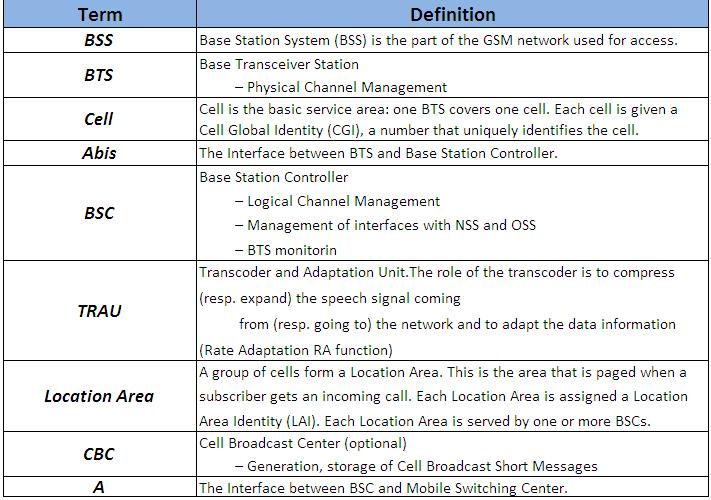
All radio-related functions are performed in the BSS, which consists of base station controllers (BSCs) and the base transceiver stations (BTSs).
  • BSC:The BSC provides all the control functions and physical links between the MSC and BTS. It is a high-capacity switch that provides functions such as handover, cell configuration data, and control of radio frequency (RF) power levels in base transceiver stations. A number of BSCs are served by an MSC.
  • BTS:The BTS handles the radio interface to the mobile station. The BTS is the radio equipment (transceivers and antennas) needed to service each cell in the network. A group of BTSs are controlled by a BSC.

The Operation and Support System

The operations and maintenance center (OMC) is connected to all equipment in the switching system and to the BSC. The implementation of OMC is called the operation and support system (OSS). The OSS is the functional entity from which the network operator monitors and controls the system. The purpose of OSS is to offer the customer cost-effective support for centralized, regional, and local operational and maintenance activities that are required for a GSM network. An important function of OSS is to provide a network overview and support the maintenance activities of different operation and maintenance organizations.

Additional Functional Elements

Other functional elements shown in Figure 2 are as follows:
  • message center (MXE):The MXE is a node that provides integrated voice, fax, and data messaging. Specifically, the MXE handles short message service, cell broadcast, voice mail, fax mail, e-mail, and notification.
  • mobile service node (MSN):The MSN is the node that handles the mobile intelligent network (IN) services.
  • gateway mobile services switching center (GMSC):A gateway is a node used to interconnect two networks. The gateway is often implemented in an MSC. The MSC is then referred to as the GMSC.
  • GSM interworking unit (GIWU):The GIWU consists of both hardware and software that provides an interface to various networks for data communications. Through the GIWU, users can alternate between speech and data during the same call. The GIWU hardware equipment is physically located at the MSC/VLR.
-------------------------------------------------------------------------

 Source : gsmfavorites

" The GSM Network " !

The Evolution of Mobile Telephone Systems

Cellular is one of the fastest growing and most demanding telecommunications applications. Today, it represents a continuously increasing percentage of all new telephone subscriptions around the world. Currently there are more than 45 million cellular subscribers worldwide, and nearly 50 percent of those subscribers are located in the United States. It is fore casted that cellular systems using a digital technology will become the universal method of telecommunications. By the year 2005, forecasters predict that there will be more than 100 million cellular subscribers worldwide. It has even been estimated that some countries may have more mobile phones than fixed phones by the year 2000.
The concept of cellular service is the use of low-power transmitters where frequencies can be reused within a geographic area. The idea of cell-based mobile radio service was formulated in the United States at Bell Labs in the early 1970s. However, the Nordic countries were the first to introduce cellular services for commercial use with the introduction of the Nordic Mobile Telephone (NMT) in 1981.
Cellular systems began in the United States with the release of the advanced mobile phone service (AMPS) system in 1983. The AMPS standard was adopted by Asia, Latin America, and Oceanic countries, creating the largest potential market in the world for cellular.
In the early 1980s, most mobile telephone systems were analog rather than digital, like today's newer systems. One challenge facing analog systems was the inability to handle the growing capacity needs in a cost-efficient manner. As a result, digital technology was welcomed. The advantages of digital systems over analog systems include ease of signaling, lower levels of interference, integration of transmission and switching, and increased ability to meet capacity demands. Table 1 charts the worldwide development of mobile telephone systems.


-----------------------------------------------------
Source: http://www.gsmfavorites.com/

" The Evolution of Mobile Telephone Systems " !

Global System for Mobile Communications ( GSM )

Global System for Mobile Communications GSM
GSM Network
Global System for Mobile Communications, or GSM (originally from Groupe Spécial Mobile), is the world's most popular standard for mobile telephone systems. The GSM Association estimates that 80% of the global mobile market uses the standard. GSM is used by over 1.5 billion people across more than 212 countries and territories.This ubiquity means that subscribers can use their phones throughout the world, enabled by international roaming arrangements between mobile network operators. GSM differs from its predecessor technologies in that both signaling and speech channels are digital, and thus GSM is considered a second generation (2G) mobile phone system. This also facilitates the wide-spread implementation of data communication applications into the system.


The GSM standard has been an advantage to both consumers, who may benefit from the ability to roam and switch carriers without replacing phones, and also to network operators, who can choose equipment from many GSM equipment vendors. GSM also pioneered low-cost implementation of the short message service (SMS), also called text messaging, which has since been supported on other mobile phone standards as well. The standard includes a worldwide emergency telephone number feature (112).
Newer versions of the standard were backward-compatible with the original GSM system. For example, Release '97 of the standard added packet data capabilities by means of General Packet Radio Service (GPRS). Release '99 introduced higher speed data transmission using Enhanced Data Rates for GSM Evolution (EDGE).


 --------------------------------------------------------------
Source: Wikipedia

" Global System for Mobile Communications ( GSM ) " !