Custom Search

Saturday, November 12, 2011

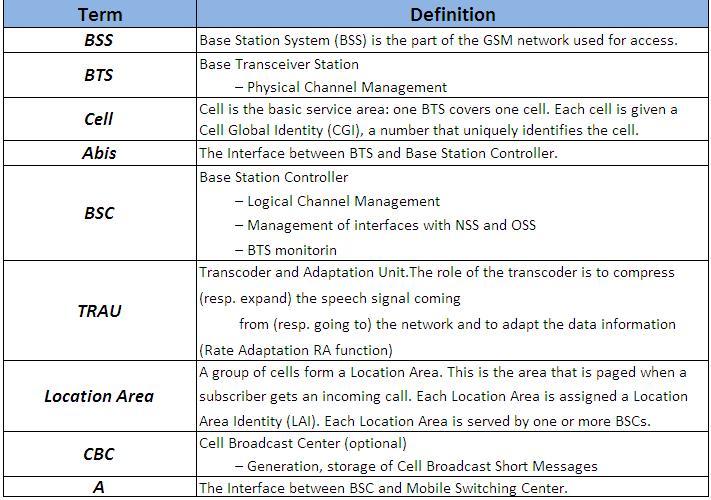
GSM Architecture and Definitions (2)


    The Network Switching System  
 

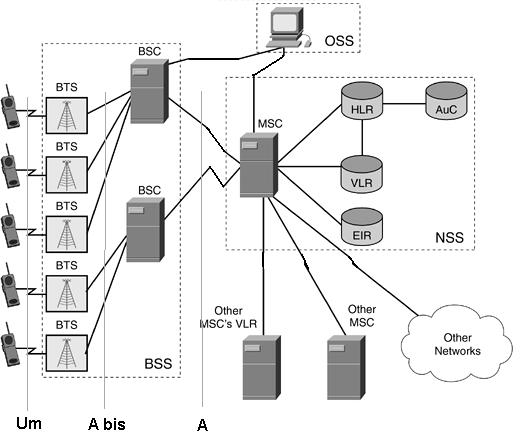
The Network switching system (NSS) is responsible for performing call processing and subscriber-related functions. The switching system includes the following functional units.

GSM Architecture and Definitions
MSC: Mobile Switching Center a switching exchange whose main functions are:
       – Call Handling
       – Specific GSM functions such as:
         • Mobility Management: Communication with the Location Databases (VLR
           and HLR)
         • Handover execution when involved
       – Gateway Function for Terminating Call (TC)
    VLR: Visitor Location Register is associated with one or more MSC. It is a local database with the following
         information:
         – Copy of the HLR data for visiting subscribers
         – More precise location of the Mobile Station (an area of the network called
           “Location Area” which is a group of cells

         – Call re-direction data


GSM Architecture and Definitions

                                                                                                                                                      Next  

Refferance:    
                   * Alcatel-Lucent    
                   * Private Line    
                   * Tutorials Point    
                   * SS7 Training


" GSM Architecture and Definitions (2) " !

GSM Architecture and Definitions (1)


    What is GSM?           

GSM, which stands for Global System for Mobile communications, reigns as the world’s most widely used cell phone technology. Cell phones use a cell phone service carrier’s GSM network by searching for cell phone towers in the nearby area.

The origins of GSM can be traced back to 1982 when the Groupe Spécial Mobile (GSM) was created by the European Conference of Postal and Telecommunications Administrations (CEPT) for the purpose of designing a pan-European mobile technology.


It is approximated that 80 percent of the world uses GSM
GSM Architecture and Definitions
technology when placing wireless calls, according to the GSM
Association (GSMA), which represents the interests of the worldwide mobile communications industry. This amounts to nearly 3 billion global people.

    GSM Network Structure   

The network is structured into a number of discrete sections:

   *  The Base Station Subsystem (the base stations and their controllers).
   *  The Network and Switching Subsystem (the part of the network most similar to a fixed network). This is sometimes also just called the core network.
   * The GPRS Core Network (the optional part which allows packet based Internet connections).
   *  The Operations support system (OSS) for maintenance of the network.
 

Now,We will explain the meaning of the GSM Network shortcuts.

PLMN: Public Land Mobile Network is area covered by one network operator. A PLMN can contain one or more MSCs.
GSM: Global System for Mobile communication
  MS: Mobile Station is used by the subscriber for calling another subscriber either in the fixed network or in the mobile network.A Mobile Station (MS) is composed of a Mobile Termination (MT) and a Subscriber Module Identity (SIM) card.
   MT: Mobile Termination.The MT performs the following functions:
       - radio transmission termination;
       - radio transmission channel management;
       - terminal capabilities, including presentation of a  man-machine interface to a user;
       - speech encoding/decoding;
       - error protection for all information sent across the radio path;
       - flow control of signalling and user data;
       - rate adaptation of user data between the radio channel rate and user rates;
       - multiple terminal support;
       - mobility management.

SIM: SIM card stores information concerning the subscriber such as subscriber identity,services subscribed, parameters for security procedures and information on the location of the subscriber (dynamically refreshed according to its movements).
  Um > The Radio Interface between MS and Base Station.
     UpLink: The Path of the Data from MS to Base Station.
     DownLink: The Path of the Data from Base Station to MS.


GSM Architecture and Definitions


GSM Architecture and Definitions

                                                                                                   Next
Refferance:
   * Alcatel-Lucent
   * Private Line
   * Tutorials Point 
  * SS7 Training


" GSM Architecture and Definitions (1) " !

Wednesday, October 19, 2011

Optical Fiber Communication


An optical fiber is a flexible, transparent fiber made of very pure glass (silica) not much wider than a human hair that acts as a waveguide, or "light pipe", to transmit light between the two ends of the fiber.The field of applied science and engineering concerned with the design and application of optical fibers is known as fiber optics.

Optical fibers are widely used in fiber-optic communications, which
Optical Fiber Communication
permits transmission over longer distances and at higher bandwidths (data rates) than other forms of communication. Fibers are used instead of metal wires because signals travel along them with less loss and are also immune to electromagnetic interference. Fibers are also used for illumination, and are wrapped in bundles so they can be used to carry images, thus allowing viewing in tight spaces. Specially designed fibers are used for a variety of other applications, including sensors and fiber lasers.

    Optical Fiber Communication       

Optical fiber can be used as a medium for telecommunication and networking because it is flexible and can be bundled as cables. It is especially advantageous for long-distance communications, because light propagates through the fiber with little attenuation compared to electrical cables. This allows long distances to be spanned with few repeaters. Additionally, the per-channel light signals propagating in the fiber have been modulated at rates as high as 111 gigabits per second by NTT,although 10 or 40 Gbit/s is typical in deployed systems.

Each fiber can carry many independent channels, each using a different wavelength of light (wavelength-division multiplexing (WDM)). The net data rate (data rate without overhead bytes) per fiber is the per-channel data rate reduced by the FEC overhead, multiplied by the number of channels (usually up to eighty in commercial dense WDM systems as of 2008[update]).

The current laboratory fiber optic data rate record, held by Bell Labs in Villarceaux, France, is multiplexing 155 channels, each carrying 100 Gbit/s over a 7000 km fiber. Nippon Telegraph and Telephone Corporation have also managed 69.1 Tbit/s over a single 240 km fiber (multiplexing 432 channels, equating to 171 Gbit/s per channel).Bell Labs also broke a 100 Petabit per second kilometer barrier (15.5 Tbit/s over a single 7000 km fiber).

For short distance applications, such as a network in an office building, fiber-optic cabling can save space in cable ducts. This is because a single fiber can carry much more data than electrical cables such as standard category 5 Ethernet cabling, which typically runs at 1 Gbit/s. Fiber is also immune to electrical interference; there is no cross-talk between signals in different cables, and no pickup of environmental noise.

Non-armored fiber cables do not conduct electricity, which makes fiber a good solution for protecting communications equipment in high voltage environments, such as power generation facilities, or metal communication structures prone to lightning strikes. They can also be used in environments where explosive fumes are present, without danger of ignition. Wiretapping (in this case, fiber tapping) is more difficult compared to electrical connections, and there are concentric dual core fibers that are said to be tap-proof.

    Real Project                                         


   References:
                    * Wikipedia  
                    * Youtube (Make Magazine Channel) 

" Optical Fiber Communication " !

Sunday, September 25, 2011

Which Screen Protector should i use?

Best Screen Protector
Screen Protector

A screen protector is used to protect the LCD screens of digital, electronic devices. The personal digital assistant (PDA) is, perhaps, the most commonly used gadget for which screen protectors are used since PDAs are operated via a stylus. If not used carefully, the tip of the stylus can potentially mar or scratch the sensitive LCD screen surface, and so screen protectors were brought to market.


The "first generation" of screen protectors were made from very thin films based on the concept that an extra layer between the two surfaces (screen and stylus) would provide the needed protection to prolong the life of the device. These screen protectors came (and still come) in packs of 10 to 20 protectors and are hand-cut by the end consumer to fit the specific device. Such screen protectors, while offering extra protection, did not completely fill the need in the marketplace. They peeled up easily and they scratched almost as easily as the screens, causing the protector to be replaced often.

The newest generation of screen protectors are made from a much more durable film and are designed to be a more permanent part of the gadget which they protect. The material is a urethane-based film which is a little thicker than traditional screen protectors (.008 inches compared to .005 or .003),[citation needed] but the film is hardly noticeable once installed. The film originated when the U.S. military was looking for a way to protect the leading edges of their military helicopter blades from abrasive airborne particles (sand) while traveling at hundreds of miles per hour. The negative is that it is hard to remove and leaves a sticky residue. It is also made in small sizes, not recommended for bigger than four inch diagonal screens. Since the film is clear, there are problems with UV rays emanating from the display to the eyes and bounce back from the sun. It also does not provide protection from glare and hard to read outdoors.

And for the usage of the cell phone screen, there are mainly 7 kinds of screen protector:

    Privacy Screen Protector                          
   As its name suggests, it is used to give users protection while they use their gadgets. When viewed from a particular angle, the privacy protector darkens your screen. It is also able to offer scratch protection if your device is touchscreen. It is the thickest screen protector available which is why it is considered to be the best type to give you protection and to keep your gadget from getting scratched. Privacy screen protectors comes in pair and can be quite expensive but if you are intent on using these, it will be worth buying.
 
     Mirror Screen Protector                              
   Mirror Screen Protector is a mirror that prevents your LCD screen from getting scratched. Mirror Screen Protector looks and works like a mirror when your phone's screen is shut off (locked). Once the screen is activated, screen contents appear like normal. Mirror Screen Protector measures 85 x 70 mm (3.35 x 2.76 in.) - cut to fit your screen. One sheet can cover more than one screen depending on size of your screens. Mirror Screen Protector does not interfere with stylus or touch screen operation. Easy to apply with no bubbles and easily removable without leaving residue.

     Matte Screen Protector                      
        ViewGuard Anti-Glare Matte Screen Protectors are composed of multiple layers of material, each of which helps to either reduce reflected light or provide additional impact protection for your screen. The anti-scratch coating layer protects your screen from fingerprints, smudges, and scratches. This layer also helps make the ViewGuard screen protector ideal for use with touch-screen tablet PCs and Ultra-Mobile PCs (UMPC). Honestly, who wants to clean fingerprints off a glossy screen all the time?
   One of the best features of the ViewGuard Anti-Glare Matte Screen Protectors is the easy on/off application. The protector is easily attached and removed time and time again without damage to your screen. The screen protector attaches directly to the surface of your display with a silicone adhesive. Since the entire multi-layer film is less than one millimeter thick it can stay attached to your screen and still allow your laptop lid to close.
 
     Ultra-Clear Screen Protector                                               
      More or less,the screen protector will reduce the clearance of the screen. In order to get the best visual effect, the ultra-clear screen protector come out. And high transparency up to 95%.
 Features:
   1. Anti-scratch,anti-grease and dust and stain-proof.
   2. No-glue , static electricity self-adhesive.
   3. No bubble,washable and reusable.
   4. Long lasting protection and firmly on screen
   5. Leave with no residue and would not corrode the surface.
   6. Easy installation .Stability adhesion performance, excellent      high  or low temperature resistance
   7. Standard packing:Color card package,PE bag,cleaning cloth,soft card. Customer package available
 
     Grid Screen Protector                            
      If the use need the screen protector looks threads,the grid screen protetor is good choose.
  Features:
   1. Anti-scratch,anti-grease and dust and stain-proof.
   2. No-glue , static electricity self-adhesive.
   3. No bubble,washable and reusable.
   4. Long lasting protection and firmly on screen
   5. Leave with no residue and would not corrode the surface.
   6. Easy installation .Stability adhesion performance, excellent high or low temperature resistance
   7. Standard packing:Color card package,PE bag,cleaning cloth,soft card. Customer package available
 
     Diamond Screen Protector                                        
         this kind of screen protector can show colorfull shine
  Features:
   1. Anti-scratch,anti-grease and dust and stain-proof.
   2. No-glue , static electricity self-adhesive.
   3. No bubble,washable and reusable.
   4. Long lasting protection and firmly on screen
   5. Leave with no residue and would not corrode the surface.
   6. Easy installation .Stability adhesion performance, excellent high or low temperature resistance
   7. Standard packing:Color card package,PE bag,cleaning cloth,soft card. Customer package available
 
     3D Screen Protector                                             
     The HTC Evo 3D Screen Protector -As an example- is the clear choice for maximum scratch protection. The HTC Evo 3D Screen Protector goes beyond your traditional HTC Evo 3D screen protectors, skins, covers, and cases. TechSkin is made from the same film material used to protect luxury cars, military aircrafts, and NASA space shuttles. The HTC Evo 3D Screen Protector is custom made to specifically fit the HTC Evo 3D .
   Features:
    * • Toughest clear protective film in the market
    * • Clear protection that is virtually invisible
    * • Preserves your HTC Evo 3D 's original design
    * • Protects your HTC Evo 3D from scratches, dents, and physical wear-and-tear
    * • Patented layer of UV protection for anti-yellowing
    * • Provides protection without affecting the functions of your HTC Evo 3D
    * • Non-sticky or restrictive outer surface


" Which Screen Protector should i use? " !

Friday, September 16, 2011

All About iPhone 4

iphone 4
iPhone 4

While everyone else was busy trying to keep up with iPhone, we were busy creating amazing new features that make iPhone more powerful, easier to use, and more indispensable than ever. The result is iPhone 4. The biggest thing to happen to iPhone since iPhone.

Facetime
People have been dreaming about video calling for decades. iPhone 4 makes it a reality. With just a tap, you can wave hello to your kids, share a smile from across the globe, or watch your best friend laugh at your stories — iPhone 4 to iPhone 4 or to the new iPod touch over Wi-Fi. And it works right out of the box. No other phone makes staying in touch this much fun.

Two cameras,two views.
iPhone 4 has two cameras: One on the front, which focuses on you. And one on the back, which focuses on everything else. FaceTime lets you switch back and forth between them at any time during a video call. All you have to do is tap a button.

Retina Display
The Retina display on iPhone 4 is the sharpest, most vibrant, highest-resolution phone screen ever, with four times the pixel count of previous iPhone models. In fact, the pixel density is so high that the human eye is unable to distinguish individual pixels. Which makes text amazingly crisp and images stunningly sharp.

Multitasking
iPhone 4 introduces a whole new way of multitasking. Now you can run your favorite third-party apps — and switch between them instantly — without slowing down the performance of the foreground app or draining the battery unnecessarily.1 This smarter approach to multitasking is available only in iOS 4.

HD Video Recording and Editing
Shoot your own movies in high definition. Capture impressive video even in low-light settings, thanks to the advanced backside illumination sensor and built-in LED light. Then edit and create your own mini-masterpiece right on iPhone 4 using the iMovie app — with Apple-designed themes, titles, and transitions. It’s available on the App Store for $4.99.

5-Megapixel Camera with LED Flash
Take beautiful, detailed photos using the 5-megapixel camera with built-in LED flash. The advanced backside illumination sensor captures great pictures even in low light. And the front-facing camera makes it easy to take self-portraits.


Reference: Apple
                 YouTube

" All About iPhone 4 " !

Wednesday, September 14, 2011

Luxury retailer introduces solid gold phone with a $60,000 price tag

Gold Phone
Gold Phone

Feature-rich smartphones aren't cheap, and critics of pricey mobile devices often claim that they are too expensive, despite their wide-ranging capabilities. Those people will want to look away now, as the newest device from Danish luxury retailer Aesir is sure to make their blood boil. Introducing the limited edition AE+Y phone — an 18-carat solid gold handset that can't use apps, email, or mobile internet, but still carries a ridiculous price of 42,000 euros (roughly $60,000).
The lavish device boasts groundbreaking features such as speed dial, call forwarding, and even a built-in calculator.


Its LCD screen measures a modest 2", and its battery can handle a measly 5 hours of talk time — compared to the Droid Bionic's 11-hour, and iPhone 4's 14-hour limits. But Aesir is focusing more on form than function, and the manufacturer is quick to point out that the edge-to-edge key design is a first in mobile handsets.

The AE+Y's barebones user interface was shaped by renowned designer Tom Hingston, and the phone's unorthodox keypad is laser-engraved and features "advanced LED backlighting." We're not quite sure how that varies from regular LED backlighting, but I guess we have to take Aesir's word on that.

Aesir's target market is clearly the super rich, but do the wealthy not also desire useful gadgets? Then again, if you're affluent enough to drop $60,000 on a solid gold phone, you're probably too busy playing polo and ordering around your servants to care about apps or email anyway.

For those of you who are only rich — as opposed to super rich — Aesir is also making a stainless steel version which will retail for a slightly less mind boggling $10,000. Both devices will debut this fall in Europe, and shortly thereafter in the U.S.
 

Source: Yahoo 

" Luxury retailer introduces solid gold phone with a $60,000 price tag " !