Custom Search

Monday, January 23, 2012

Stop paying PER Device for Wi-Fi access!


    It's Easy as 1,2,3!
Access Internet by your Cell Phone through WiFi


1: Set your desired Hotspot name and password.

2: Select which Internet connection you'd like to share.

3:Click Start Hotspot.


    Stop paying PER Device for Wi-Fi access!


If you have to pay for Wi-Fi, at least make it work for you!
Create a Connectify hotspot and get all your devices online simultaneously without paying outrageous fees.


     Weak Wi-Fi Signal or Wired Only?        

With Connectify you can wirelessly share the Internet connection in your room with your phone, tablet, gaming system, and other equally important study tools.

Connectify Download 

" Stop paying PER Device for Wi-Fi access! " !

Tuesday, January 3, 2012

Code Division Multiple Access (CDMA)


    CDMA         

Short for Code-Division Multiple Access, a digital cellular technology that uses spread-spectrum techniques. Unlike competing systems, such as GSM, that use TDMA, CDMA does not assign a specific frequency to each user. Instead, every channel uses the full available spectrum. Individual conversations are encoded with a pseudo-random digital sequence. CDMA consistently provides better capacity for voice and data communications than other commercial mobile technologies, allowing more subscribers to connect at any given time, and it is the common platform on which 3G technologies are built.


Code Division Multiple Access (CDMA)

CDMA users share a common frequency channel. All users are on the same frequency at the same time. However, each pair of users is assigned a special code that reduces interference while increasing privacy.

    Advantages of CDMA

Most efficient use of available bandwidth the foremost advantage is the large band width and its equivalent effect utilization for sending and receiving the data.

No separate time Access divisions
In CDMA technology there is no time limitation slot division for using the band width and sending and receiving the data like in TDMA.

Power and bandwidth frequency
Power frequency remains constant in both sending and receiving and uniform bandwidth keeps the transmission faster and in time.

Resource allocation
Another advantage of CDMA is the flexible resource allocation which means that a certain kind of pin code is provide to the active users to communicate with each other. Fixed time and bandwidth keeps the simultaneous exchange of message at both sender and receivers end and specific number of packets with limited length keeps the extra traffic out of the channel.

    Disadvantages of CDMA     

The main disadvantage of CDMA is that it can’t be used for the multi channel or multiple transmission paths. All the communication is performed over a single path. This make it fixed for singular purposes which is main drawback of CDMA technology.

    Space Division Multiple Access (SDMA)  

Space Division Multiple Access (SDMA) - A variation of TDMA and CDMA that potentially will be used in high-bandwidth, third-generation wireless products.

SDMA is a channel access method based on creating parallel spatial pipes next to higher capacity pipes through spatial multiplexing and/or diversity, by which it is able to offer superior performance in radio multiple access communication systems. In traditional mobile cellular network systems, the base station has no information on the position of the mobile units within the cell and radiates the signal in all directions within the cell in order to provide radio coverage. This results in wasting power on transmissions when there are no mobile units to reach, in addition to causing interference for adjacent cells using the same frequency, so called co-channel cells. Likewise, in reception, the antenna receives signals coming from all directions including noise and interference signals. By using smart antenna technology and differing spatial locations of mobile units within the cell, space-division multiple access techniques offer attractive performance enhancements. The radiation pattern of the base station, both in transmission and reception, is adapted to each user to obtain highest gain in the direction of that user. This is often done using phased array techniques.

     Comparison of Multiple Access Systems

 
Comparison of Multiple Access Systems_CDMA_FDMA_TDMA
Comparison of Multiple Access Systems

This table summarizes some of the technical aspects of the multiple access technologies.

The technology used determines the channel's capacity. TDMA triples the capacity of FDMA, but CDMA capacity can be up to seven times that of TDMA.

References:
                   WiFi Notes
                   Wikipedia
                   CDMA University
                   WEBOPEDIA
                   How Stuff Works


" Code Division Multiple Access (CDMA) " !

Saturday, December 10, 2011

Frequency Division Multiple Access (FDMA)


    FDMA                           
Multiple Access Systems-Frequency Division Multiple Access (FDMA)
Frequency Division Multiple Access (FDMA)

Frequency Division Multiple Access or FDMA is a channel access method used in multiple-access protocols as a channelization protocol. FDMA gives users an individual allocation of one or several frequency bands, or channels. It is particularly commonplace in satellite communication. FDMA, like other Multiple Access systems, coordinates access between multiple users.

Each FDMA subscriber is assigned a specific frequency channel. No one else in the same cell or a neighboring cell can use the frequency channel while it is assigned to a user. This reduces interference, but severely limits the number of users.

    Advantage of FDMA                         
 
* FDMA technique doesn't need any base-control station.
* Data that transfeered between each station to another during the transmission process will not be lost.
* After the transmission of data,the effect ot the delay distortion will be so small and it can be ignored.
* There is no need for network timing.
* The channel operations in FDMA are simple.
* In FDMA,the reduction of the information bit rate has a good effect on the capacity.
* No need for any equalization.
* Because of the transmission is continuous,there is almost no need for bits that are responsible for synchronization.
* Simplicity in FDMA algorithms.

    Disadvantages of FDMA                   


* In the FDMA technique,it is impossible for the stations to receive data from more than one transmission source.
* One of most important thing in communication systems is the maximum data rate which is small and fixed for every channel in FDMA.
* Because of the guard bands,the capacity of the FDMA will be decreased.
* Increasing the cost of FDMA,since the band filters are narrow that can't be recognized by VLSI.
* FDMA requires special filters to avoid any interference between the narrow channels.


    TDMA                        
    CDMA                       
    SDMA                        

Reference:

    * Wikipedia
    * CDMA University
    * WEBOPEDIA
    * How Stuff Works   


" Frequency Division Multiple Access (FDMA) " !

Friday, December 9, 2011

Multiple Access Systems


    Why Multiple Access?  
 

Multiple Access systems coordinates access between multiple users.Wireless telecommunications has dramatically increased in popularity, resulting in the need for technologies that allow multiple users to share the same Bandwidth.
The following Multiple Access Systems have very different approaches to the bandwidth problem. 


Multiple Access Systems-Time Division Multiple Access (TDMA)
Time Division Multiple Access (TDMA)

     TDMA                       

Short for Time Division Multiple Access, a technology for delivering digital wireless service using time-division multiplexing (TDM). TDMA works by dividing a radio frequency into time slots and then allocating slots to multiple calls. In this way, a single frequency can support multiple, simultaneous data channels.
The users transmit in rapid succession, one after the other, each using its own time slot. This allows multiple stations to share the same transmission medium (e.g. radio frequency channel) while using only a part of its channel capacity. TDMA is used in the digital 2G cellular systems such as Global System for Mobile Communications (GSM), IS-136, Personal Digital Cellular (PDC) and iDEN, and in the Digital Enhanced Cordless Telecommunications (DECT) standard for portable phones. It is also used extensively in satellite systems, combat-net radio systems, and PON networks for upstream traffic from premises to the operator.
TDMA is a type of Time-division multiplexing, with the special point that instead of having one transmitter connected to one receiver, there are multiple transmitters. In the case of the uplink from a mobile phone to a base station this becomes particularly difficult because the mobile phone can move around and vary the timing advance required to make its transmission match the gap in transmission from its peers.
 

    Advantages of TDMA                       

The radio part of the mobile only needs to listen and broadcast for its own time slot. For the rest of the time, the mobile can carry out measurements on the network, detecting surrounding transmitters on different frequencies. This allows safe inter frequency handovers, something which is difficult in CDMA systems, not supported at all in IS-95 and supported through complex system additions in Universal Mobile Telecommunications System (UMTS). This in turn allows for co-existence of microcell layers with macrocell layers.


    Disadvantages of TDMA                 

TDMA systems create interference at a frequency which is directly connected to the time slot length. This is the buzz which can sometimes be heard if a TDMA phone is left next to a radio or speakers.Another disadvantage is that the "dead time" between time slots limits the potential bandwidth of a TDMA channel. These are implemented in part because of the difficulty in ensuring that different terminals transmit at exactly the times required. Handsets that are moving will need to constantly adjust their timings to ensure their transmission is received at precisely the right time, because as they move further from the base station, their signal will take longer to arrive. This also means that the major TDMA systems have hard limits on cell sizes in terms of range, though in practice the power levels required to receive and transmit over distances greater than the supported range would be mostly impractical anyway.


    FDMA                        
    CDMA                       
    SDMA                        

Reference:
    
    * Wikipedia 
    * CDMA University
    * WEBOPEDIA
    * How Stuff Works


" Multiple Access Systems " !

Friday, November 18, 2011

Cell Phone Network Coverage


Network coverage

A key part of any mobile phone specification is its operating frequency bands. The supported frequency bands determine
whether a certain handset is compatible with a certain network carrier.


Cell Phone Network Coverage,GSM,2G,3G
Cell Phone Network Coverage
Beside the mobile phone specifications, GSM Arena is happy to also provide you with its own country-based frequency band directory. It's not operator-specific and it's helpful if you are choosing a handset to use in your home country or if you are making sure your phone will work in the country you are heading to.
You select the country you are interested in - as an example i selected Egypt - :

EGYPT

GSM 850     GSM 900     GSM 1800     GSM 1900     UMTS 850     UMTS 1900     UMTS 2100
  No               Yes               Yes                 No                  No                   No                    Yes   


Making calls, sending text messages and using GPRS/EDGE mobile data connection in the country of your choice requires a mobile phone that supports at least the frequency band filled as “Required” below.

2G capabilities

Required   GSM 900
Recommended   GSM 900 and GSM 1800

Making video calls and using a high-speed 3G data connection in the country of your choice, requires a mobile phone that supports at least the frequency band filled as “Required” below .

3G capabilities

Required   UMTS 2100


Make note that for complete accuracy you should always check with your home service provider or with the local service providers in the country you are staying at.

Check Network Coverage for your Country GSM Arena - Network Bands

Source:
                  * GSM Arena


" Cell Phone Network Coverage " !

Saturday, November 12, 2011

GSM Architecture and Definitions (3)


    The Operation and Support System 

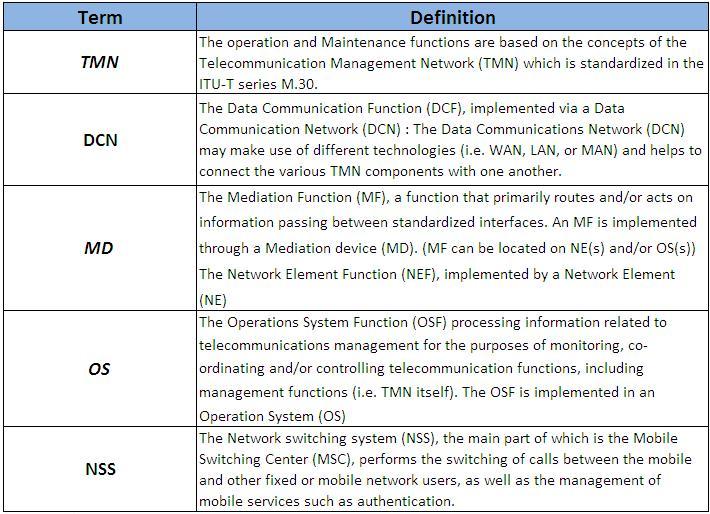
The operations and maintenance center (OMC) is connected to all equipment in the switching system and to the BSC. The implementation of OMC is called the operation and support system (OSS). The OSS is the functional entity from which the network operator monitors and controls the system. The purpose of OSS is to offer the customer cost-effective support for centralized, regional, and local operational and maintenance activities that are required for a GSM network. An important function of OSS is to provide a network overview and support the maintenance activities of different operation and maintenance organizations.


GSM Operation and Support System (OSS)
OSS: The operations and maintenance center (OMC) is connected to all equipment in the switching system and to the BSC. The implementation of OMC is called the operation and support system (OSS).
       Here are some of the OMC functions:
       * Administration and commercial operation (subscription, end terminals, charging and statistics).
       * Security Management.
       * Network configuration, Operation and Performance Management.

       * Maintenance Tasks.    

GSM Architecture and Definitions


GPRS (General Packet Radio Services
GPRS (General Packet Radio Services)

    
GPRS General Packet Radio Services

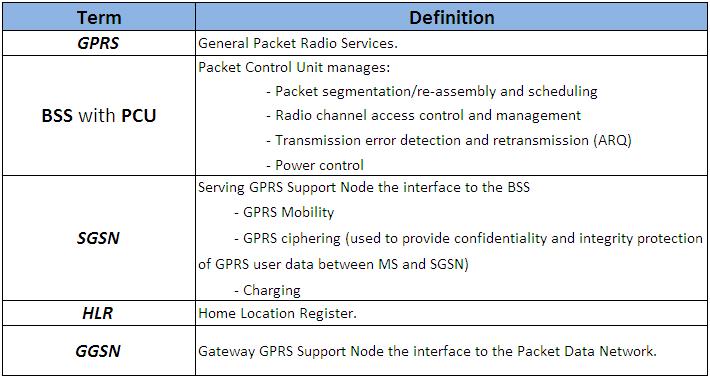
GPRS is a data network that overlays a second-generation GSM network. This data overlay network provides packet data transport at rates from 9.6 to 171 kbps. Additionally, multiple users can share the same air-interface resources simultaneously.

GPRS attempts to reuse the existing GSM network elements as much as possible, but to effectively build a packet-based mobile cellular network, some new network elements, interfaces, and protocols for handling packet traffic are required.


GSM Architecture and Definitions


External Networks
  PSTN: Public Switched Telephone Network
  ISDN: Integrated Services Digital Network
  PDN: Packet Data Network

Refferance:
   * Alcatel-Lucent
   * Private Line
   * Tutorials Point 
  * SS7 Training


" GSM Architecture and Definitions (3) " !